
Free Markup Calculator
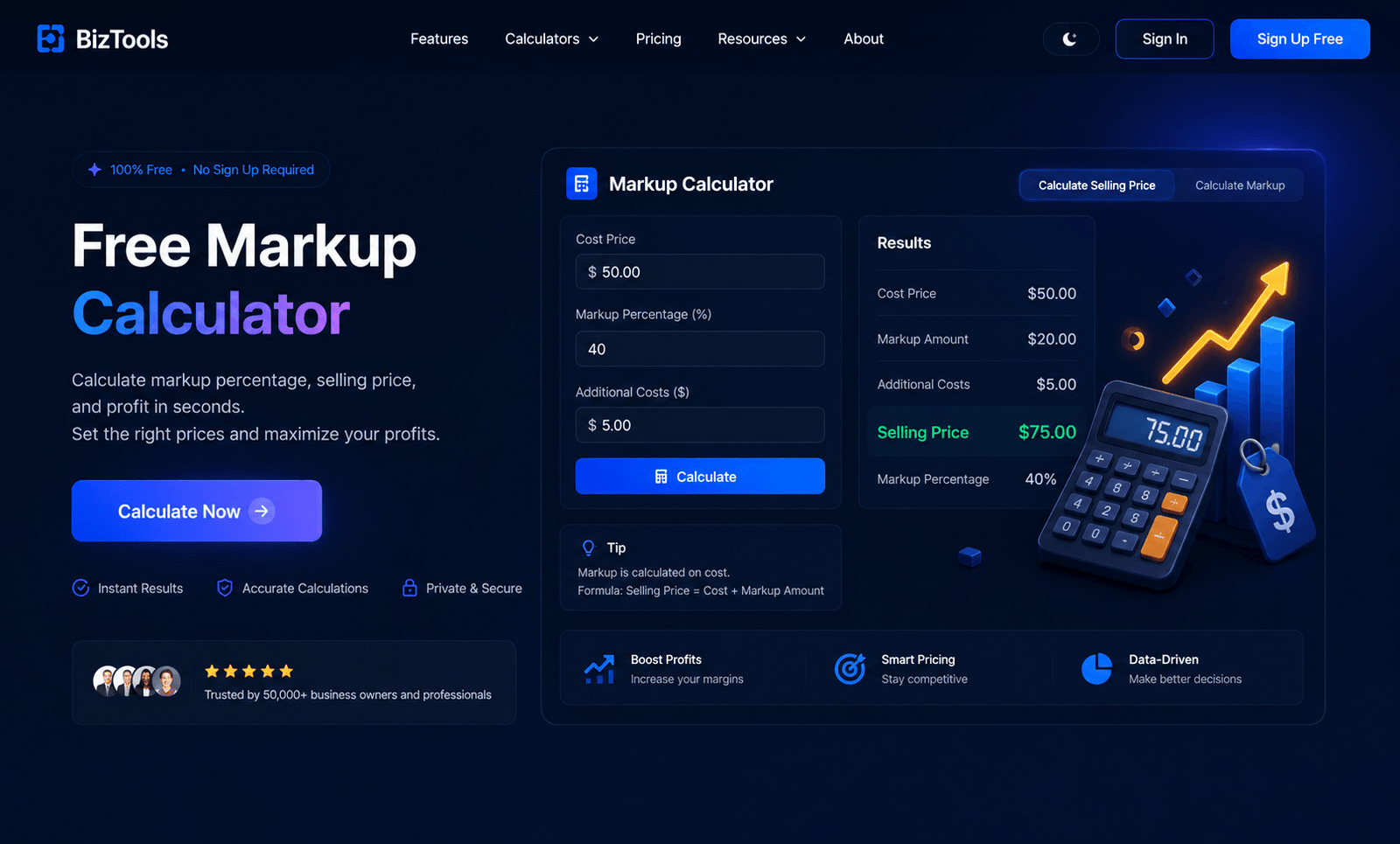
Calculate your selling price, gross profit and profit margin instantly. Enter your item cost and desired markup below.
Your Pricing Results
All calculations are estimates based on your input values.
Free Markup Calculator
Use our free Markup Calculator to instantly analyze product markup percentages, profit margins, and total sales revenues. This business tool helps ecommerce sellers and freelancers calculate their exact retail pricing strategies in seconds.
Trusted by ecommerce sellers & entrepreneurs
Why Use This Calculator?
Professional-grade accuracy meets an effortless user experience.
Save Time Instantly
Experience rapid calculations that deliver results in seconds, eliminating the need for manual formula work.
Avoid Costly Mistakes
Ensure precision with automated calculations that minimize errors in pricing and profit assessments.
Improve Pricing Decisions
Gain insights into your profit margins to make informed and strategic pricing choices for your business.
No Spreadsheets Needed
Bypass the complexity of Excel and perform all your calculations directly online with ease.
User-Friendly Interface
Navigate effortlessly through a sleek, intuitive design that enhances your calculation experience.
Instant Results
Get immediate feedback on your financial metrics, allowing for quick adjustments and decisions.
Who is this for?

Ecommerce Sellers
Track margins before ad costs
destroy profits.

Freelancers
Price your services profitably and
confidently.

Small Businesses
Monitor pricing and profitability
in seconds.

Marketers
Calculate campaign profitability
and ROI faster.
How To Use The Markup Calculator
Follow these three simple steps to determine your ideal retail pricing in seconds.
Enter Unit Cost
Start by inputting the total cost of your product or service to establish your baseline.
Set Desired Markup
Input your desired markup percentage to automatically calculate your target retail price.
Review Your Price
Instantly view your recommended selling price, total gross profit, and resulting profit margin.
Understanding the Math
Our calculator does the heavy lifting, but here is the transparent logic behind every result.
Markup Formula
This formula shows the percentage added to your unit cost to determine your final retail price.
Frequently Asked Questions
Everything you need to know about profit margins, markup, and business profitability.
Markup is the amount or percentage added to the cost price of a product or service to calculate its final retail selling price. It represents the difference between what it costs you to produce or buy an item and the price you charge your customers, helping cover operating overhead expenses and generate a net profit.
To calculate markup percentage manually, take your total gross profit (Selling Price minus Cost Price), divide it by the original Cost Price, and then multiply the result by 100. Formula: Markup Percentage = ((Price - Cost) / Cost) × 100
While both terms measure business profitability, they use different baselines. Markup is calculated as a percentage of the cost price (how much you add to cost to get to price). Profit margin is calculated as a percentage of the final selling price (the portion of total revenue that remains as profit after expenses are deducted).
No, a 50% markup results in a 33.3% profit margin. For example, if an item costs $100 and you apply a 50% markup ($50), your selling price is $150. Your profit is $50, which is exactly 33.3% of your $150 total revenue.
A "good" markup varies heavily by industry, business model, and sales volume. A classic retail standard is a 50% markup (known as "keystone pricing"), which doubles the cost price. Wholesale items often have a lower markup around 20%, whereas luxury goods, apparel, and restaurant industries frequently utilize markups exceeding 100% to 300%.
If you know your target profit margin and want to find the corresponding markup percentage required to achieve it, you can use a quick conversion formula. Divide your profit margin by 1 minus that profit margin. Formula: Markup = Margin / (1 - Margin) (Using decimals, e.g., a 20% margin is 0.20 / 0.80 = 25% markup).
Related Business Calculators
Explore more free business calculators designed for ecommerce sellers, entrepreneurs, freelancers, and growing online businesses.
Loan Calculator
Estimate monthly repayments and total interest costs for business loans and commercial lines of credit.
Try CalculatorGST Calculator
Quickly calculate Goods and Services Tax for sales and expenses to simplify your business tax filings.
Calculate NowCompound Interest
Project long-term wealth growth and investment gains using standard compound interest formulas.
Try CalculatorVAT Calculator
Instantly determine Value Added Tax amounts for international transactions and European market sales.
Calculate NowMastering Markups
Level up your retail pricing strategy with our curated business guides and financial frameworks.






Understanding Markups
Ecommerce Markup
Ecommerce brands use markups to cover digital overhead like shipping, ad spend, and platform fees. Calculating the right percentage ensures your online store remains competitive while protecting your bottom line.
Service Markup Guide
For online service providers, markups help translate labor hours and expertise into a sustainable price point. Regularly auditing your markup helps you scale and adjust for rising operational costs.
Retail Markup Factors
Retail profit margins vary wildly depending on the industry and competition. Retailers often work with specific markup percentages to account for shelf space, inventory holding costs, and brand positioning.
Markup vs Margin
The two are often confused: Markup is the percentage added to the cost to reach a price, while margin is the percentage of the selling price that is profit. Knowing the difference is key to accurate financial reporting.
Ready to scale your Profitability?
Don't lose your progress. Bookmark this tool to keep your margins in check during your next product launch or service pricing update.