
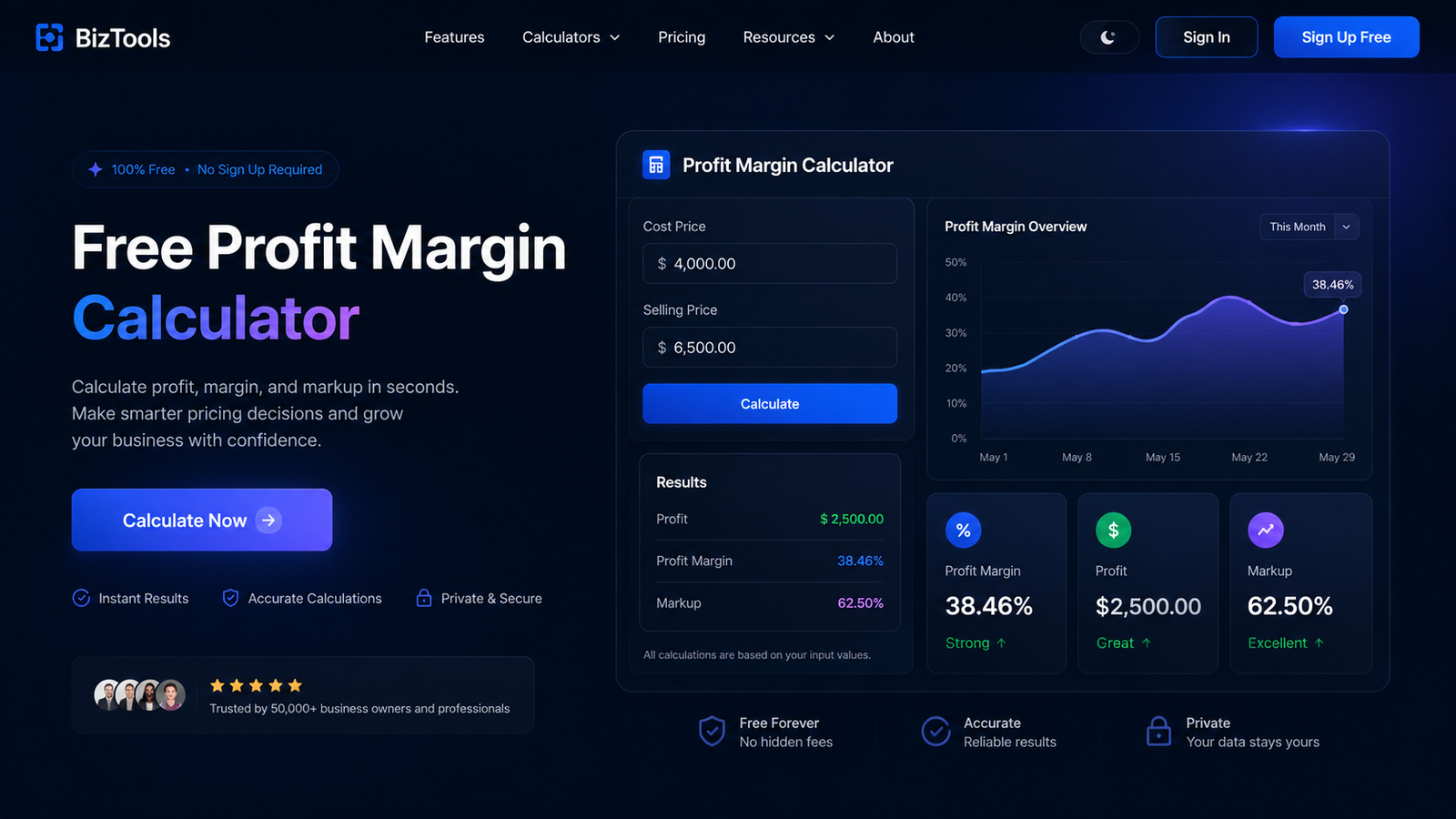
Free Profit Margin Calculator
Instantly calculate your gross profit, profit margin and markup.
Your Results
Enter your cost and selling price to see what your numbers mean.
Instant profit margin analysis
All calculations are estimates based on your input values.
Free Profit Margin Calculator
Use our free Profit Margin Calculator to instantly analyze product profitability, markups, and net revenue. This business tool helps ecommerce sellers and freelancers find their exact numbers in seconds.
Trusted by ecommerce sellers & entrepreneurs
Why Use This Calculator?
Professional-grade accuracy meets an effortless user experience.
Save Time Instantly
Experience rapid calculations that deliver results in seconds, eliminating the need for manual formula work.
Avoid Costly Mistakes
Ensure precision with automated calculations that minimize errors in pricing and profit assessments.
Improve Pricing Decisions
Gain insights into your profit margins to make informed and strategic pricing choices for your business.
No Spreadsheets Needed
Bypass the complexity of Excel and perform all your calculations directly online with ease.
User-Friendly Interface
Navigate effortlessly through a sleek, intuitive design that enhances your calculation experience.
Instant Results
Get immediate feedback on your financial metrics, allowing for quick adjustments and decisions.
Who is this for?

Ecommerce Sellers
Track margins before ad costs
destroy profits.

Freelancers
Price your services profitably and
confidently.

Small Businesses
Monitor pricing and profitability
in seconds.

Marketers
Calculate campaign profitability
and ROI faster.
How To Use This Calculator
Follow these three simple steps to unlock deep financial insights in seconds.
Enter Cost Price
Start by inputting the total cost of your product or service to begin the calculation process.
Enter Selling Price
Next, add the price at which you intend to sell your product to customers.
View Results Instantly
Immediately see your profit margin, markup, and profit calculations displayed clearly.
Understanding the Math
Our calculator does the heavy lifting, but here is the transparent logic behind every result.
Profit Margin Formula
This formula reveals the exact percentage of every dollar that stays in your pocket after expenses are settled.
Frequently Asked Questions
Everything you need to know about profit margins, markup, and business profitability.
Profit margin represents the percentage of revenue that remains after all costs and expenses are deducted. It's a key indicator of your business's overall financial health and pricing efficiency.
The standard formula is: ((Total Revenue - Cost) / Total Revenue) x 100. Our calculator automates this for you instantly.
Margin is based on the selling price, while markup is based on the original cost. Margin measures profit against revenue, whereas markup indicates how much the price is increased above cost.
Yes. A negative profit margin occurs when your cost of goods sold (COGS) and expenses exceed your total revenue, indicating the business is losing money on every sale.
Benchmarks vary by industry. For example, retail often sees 5-10%, while software (SaaS) can reach 70% or more. Generally, a 10% net margin is considered average, while 20% is high.
Common causes include rising supplier costs, excessive discounting, high overhead expenses, or fierce market competition forcing lower prices.
Related Business Calculators
Explore more free business calculators designed for ecommerce sellers, entrepreneurs, freelancers, and growing online businesses.
Loan Calculator
Estimate monthly repayments and total interest costs for business loans and commercial lines of credit.
Try CalculatorGST Calculator
Quickly calculate Goods and Services Tax for sales and expenses to simplify your business tax filings.
Calculate NowCompound Interest
Project long-term wealth growth and investment gains using standard compound interest formulas.
Try CalculatorVAT Calculator
Instantly determine Value Added Tax amounts for international transactions and European market sales.
Calculate NowMastering Profit Margins
Master the mechanics of profitability through our curated business guides and strategic frameworks.

Introduction to Profit Margins
Gain a comprehensive understanding of margins and their critical significance in daily business operations.
Enroll Now →
Profit Margin Strategies
Learn effective, battle-tested strategies to optimize pricing and enhance your business's net profit yield.
Start Learning →
Gross vs Net Margins
Explore the vital differences between gross and net profit margins with practical, real-world examples.
Discover More →
Calculating Profit Margins
Master the formulas and variable calculations needed to accurately determine margins for any product.
Learn Calculations →
Improving Profit Margins
Identify actionable steps to reduce COGS, lower overhead, and boost your overall bottom-line profitability.
Improve Now →
Common Margin Mistakes
Avoid the common pitfalls and accounting errors that can silently erode your business's profit margins.
Avoid Mistakes →Understanding Profit Margins
Ecommerce Profit Margin
Ecommerce businesses often operate with tighter profit margins due to advertising costs, shipping fees, payment processing charges, and product returns. Monitoring these regularly helps online store owners optimise pricing and maintain profitability.
Online Business Margin Calculator
An online business margin calculator helps entrepreneurs quickly determine whether their products or services are profitable. Calculating margins regularly can improve pricing decisions, budgeting, and long-term business growth.
Retail Profit Margin
Retail profit margins vary depending on the industry, product type, and competition. Grocery stores and discount retailers often work with lower margins, while specialty products and luxury goods typically achieve higher profit margins.
Markup vs Margin
Markup and margin are often confused, but they are calculated differently. Markup measures how much a product price exceeds its cost, while profit margin measures how much profit remains from total revenue after costs are deducted.
Ready to scale your Profitability?
Don't lose your progress. Bookmark this tool to keep your margins in check during your next product launch or service pricing update.